One God for all
Sikhs believe in one Creator — Ik Onkar — present in all creation, beyond birth and death, and accessible to everyone through love and remembrance.
Faith
A faith of one God, the equality of all people, honest living, and selfless service.
Sikhism is a monotheistic religion founded in 15th-century Punjab on the teachings of Guru Nanak Dev Ji and the nine Gurus who followed him. The eternal Guru of the Sikhs is the sacred scripture, Guru Granth Sahib Ji.
At its heart, Sikhism teaches that there is one God for all of humanity, that every person is equal regardless of caste, gender, or background, and that a spiritual life is lived through honest work, remembrance of the Divine, and service to others. With over 25 million followers worldwide, it is one of the world’s major faiths.
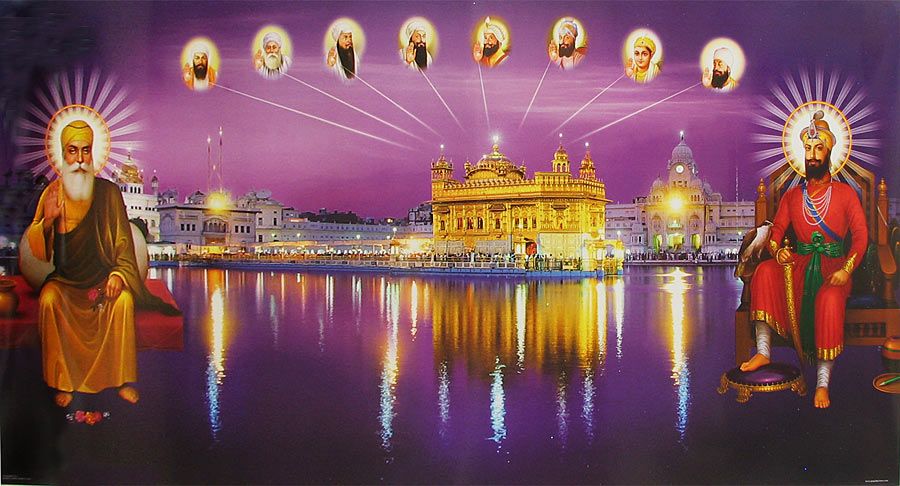
What Sikhs believe
Sikhs believe in one Creator — Ik Onkar — present in all creation, beyond birth and death, and accessible to everyone through love and remembrance.
Every person is equal regardless of gender, caste, race, or wealth. This truth is lived out when all sit together on the floor and share Langar as one family.
Serving others without expectation of reward is central to Sikhi. Seva is offered in the kitchen, in cleaning, and in caring for the community.
Sikhs are encouraged to earn an honest livelihood, remember God amid daily life, and share generously with others.
The foundation of a Sikh life
Naam Japna
Keeping the Divine in mind at all times through meditation, prayer, and the loving remembrance of Waheguru.
Kirat Karni
Living truthfully and earning one's livelihood through honest, hard work — without exploitation or deceit.
Vand Chakna
Sharing one's earnings and time with the community and those in need, embodied in Langar and Seva.
Ik Onkar
One Creator of all
Born 1469 · Nankana Sahib
The first Guru
Guru Nanak Dev Ji, the founder of Sikhism, was born in 1469 in “Rai Bhoe Ki Talwandi” — now Nankana Sahib, near Lahore in present-day Pakistan — to his father Mehta Kalu and mother Tripta, with an elder sister named Nanki.
From childhood, he questioned caste distinctions and idol worship, teaching instead the oneness of God and the equality of all people. He travelled extensively across South Asia and beyond, spreading a message of love, honest living, and devotion. His birth anniversary (Gurpurab) is celebrated on the full moon of the month of Katak (October–November).

The articles of faith
Given by Guru Gobind Singh Ji, the Five Ks are articles of faith worn by initiated Sikhs as a commitment to their beliefs and identity.
Uncut hair, kept covered with a turban — a respect for the natural form as created by God.
A wooden comb, symbolizing cleanliness and discipline of body and mind.
A steel bracelet, a reminder of restraint and of one's bond with the Guru.
A cotton undergarment, representing self-control and readiness to serve.
A small ceremonial sword, symbolizing the duty to defend the weak and uphold justice.
Throughout the year
Celebrations of the birth or life of the Gurus, especially Guru Nanak Dev Ji and Guru Gobind Singh Ji.
Marks the founding of the Khalsa in 1699 by Guru Gobind Singh Ji — a joyful spring festival.
Celebrates the release of Guru Hargobind Ji and, with him, many others from imprisonment.